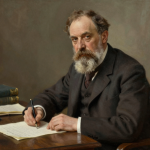
Melanie Klein
Melanie Klein was one of the most important psychoanalysts of the twentieth century and a decisive figure in the development of object relations theory. Her work transformed the understanding of infancy, anxiety, aggression, phantasy, and the internal world of relationships. Klein’s historical importance lies not only in the concepts she introduced but in the way she reoriented psychoanalysis toward the earliest layers of emotional life. She remains central because many later debates about development, psychosis, mourning, envy, and technique unfolded in direct relation to her ideas.
Biography and trajectory
Klein was born in Vienna in 1882 and later worked in Budapest, Berlin, and London. Her path into psychoanalysis differed from Freud’s medical route. She developed her thought through analytic training, clinical observation, and intensive work with children. This background shaped both the originality and the controversy of her method. Instead of assuming that children were too young for analytic inquiry, Klein treated play as a form of symbolic expression comparable to speech in adult analysis. That move expanded the scope of psychoanalysis and forced a reconsideration of developmental timing.
Her migration to Britain and the institutional debates that followed made Klein a central figure in the history of psychoanalytic institutions. Disputes around technique, theory, and training often turned on whether her account of early mental life was too radical or clinically indispensable. Whatever position later analysts took, Klein had altered the field permanently.
Major concepts
Klein is especially associated with unconscious phantasy, projective identification, splitting, and the distinction between the paranoid-schizoid and depressive positions. These ideas proposed that intense anxieties and object relations organize psychic life from a very early stage. In her view the infant does not begin in a simple state of undifferentiated harmony. Early life is structured by primitive fears, destructive impulses, dependence on the object, and the gradual capacity to integrate love and hate.
The depressive position became one of her most influential formulations because it describes a movement toward recognizing that the loved and hated object are one and the same. This recognition opens the possibility of guilt, concern, reparation, and more stable relational life. By contrast, splitting and persecutory anxiety are linked to states in which experience is divided between idealized and threatening objects. These ideas became foundational for later work on borderline states, trauma, and internal object relations.
Technique and child analysis
Klein’s clinical method emphasized the immediacy of unconscious phantasy as it appears in play, speech, anxiety, and the transference. She interpreted aggressively and often earlier than many contemporaries thought advisable. Supporters regarded this as necessary precision; critics worried that such interpretations could overreach. Regardless of that debate, her work established child analysis as a serious psychoanalytic domain and gave later clinicians a new vocabulary for thinking about primitive anxieties and symbolic play.
Her influence also extended well beyond child work. Adult analysis was reshaped by her attention to envy, internal object relations, and the ongoing force of early emotional configurations. Concepts now common in psychoanalytic thinking, including certain uses of projective processes and reparation, owe much to Klein’s line of thought. Articles such as Object Relations Theory and Kleinian School build directly on this inheritance.
Legacy
Klein’s legacy is both theoretical and institutional. A distinct Kleinian current developed in Britain and later influenced analysts in many countries. At the same time, even traditions that do not identify as Kleinian often rely on concepts that became thinkable through her work. She changed how psychoanalysis understands early development, aggression, envy, and the constitution of the inner world.
Her work remains controversial in productive ways. Some readers question the developmental claims or the density of interpretation, while others see in Klein one of the clearest accounts of how primitive emotional life continues to shape adult experience. That tension is part of why her writing still occupies a central place in psychoanalytic education and debate.
References
- Klein, Melanie. The Psycho-Analysis of Children.
- Klein, Melanie. Envy and Gratitude.
- Segal, Hanna. Introduction to the Work of Melanie Klein.
Official link: Melanie Klein Trust